
Last Updated: November 19, 2026
Quick Summary
Yes, you can apply grub control and fertilizer together in most cases, on the same day and in the same spreader pass, as long as the labels on both bags allow it. Apply them as two separate passes rather than blending them in one hopper, and follow the stricter label when watering instructions conflict.
- Apply the fertilizer first, then reset the spreader and apply grub control at a right angle.
- Never pour both products into one hopper, because mixing causes uneven coverage and hot spots.
- If the two labels conflict on watering, the stricter label wins and you may need to split the applications.
- Preventative grub control must go down before eggs hatch, so set your window with local extension guidance.
- Spreader settings are brand-specific, so use the chart for your model or calibrate it yourself.
Table of Contents
- Applying Grub Control and Fertilizer Together: The Short Answer
- Applying Together Is Not the Same as Mixing Them
- Read the Product Label Before You Do Anything
- How to Apply Fertilizer With Grub Control in One Pass
- Watering After Application: Why the Two Products Disagree
- When to Apply Grub Control for Preventative Results
- GrubEx Application Rate and Spreader Settings That Matter
- Request a Quote for a Program That Handles Both
- Frequently Asked Questions
Applying Grub Control and Fertilizer Together: The Short Answer
Yes, you can apply grub control and fertilizer together in most cases. The two products can go down on the same day, in the same spreader pass, as long as the labels on both bags allow it.
That answer comes with one condition. You are applying two products back to back, not blending them into one hopper load unless the label says otherwise.
Here is what most guides get wrong: they answer “yes” and stop. The real work is in the label.
Applying Together Is Not the Same as Mixing Them
Applying together means two separate products go on the same lawn on the same day. Mixing means physically combining them in one spreader hopper or one spray tank.
Those are different things, and only one of them is usually allowed.
- Applying together: product A goes down, then product B goes down. Two passes, one afternoon.
- Mixing: both products poured into the same hopper. This is where you get uneven coverage and hot spots.
- Tank mixing: combining liquid formulas in one sprayer. Only do this if both labels list the other product as compatible.
A common mistake is dumping a half bag of fertilizer and a half bag of grub control into the spreader to “save a trip.” You end up with one part of the lawn getting too much of one product and not enough of the other. Two passes take twenty extra minutes.
Here is how the two approaches differ, and why only one is usually allowed.
| Approach | What it means | Key risk |
|---|---|---|
| Applying together | Product A goes down, then product B | None if labels allow |
| Mixing | Both products poured into the same hopper | Uneven coverage and hot spots |
| Tank mixing | Combining liquid formulas in one sprayer | Only if both labels list compatibility |
Read the Product Label Before You Do Anything
The label is the only authority on whether your two products can share a day. Everything else, including this article, is a starting point.
Read the label on both bags and check four things:
- Application timing. Does the grub product say spring, early summer, or fall? Does the fertilizer match that window?
- Watering instructions. One product may need water worked in; the other may need to stay dry for a day.
- Restrictions. Some grub products limit how soon you can overseed or apply weed killer.
- Rate per 1,000 square feet. Both bags give a rate. You need both numbers before you calibrate.
If the labels conflict, the stricter label wins. If one product says “water in immediately” and the other says “apply to dry grass and keep dry for 24 hours,” you cannot satisfy both on the same day.
Watch out: applying a grub product outside its labeled window because the fertilizer was due that week is the fastest way to waste money. The grub product does nothing if the larvae are not active or the soil is too cold.
How to Apply Fertilizer With Grub Control in One Pass
The clean way to do this is two passes with one spreader, not one pass with a mixed hopper.
- Measure the lawn. Length times width for each rectangle, then add the sections. You need total square footage to set your rates.
- Calibrate the spreader. Run a test with plain product over a tarp or driveway, weigh what comes out, and adjust the setting until you hit the label rate.
- Apply the fertilizer first. Walk the full lawn in straight, overlapping passes. Close the hopper at every turn.
- Apply the grub control second. Reset the spreader to the grub product’s rate and walk the lawn again, this time at a right angle to your first pattern.
- Water according to the stricter label. If both products want water, one pass with the hose or sprinkler covers both.
- Clean the spreader. Rinse it away from storm drains and keep the runoff off hard surfaces.
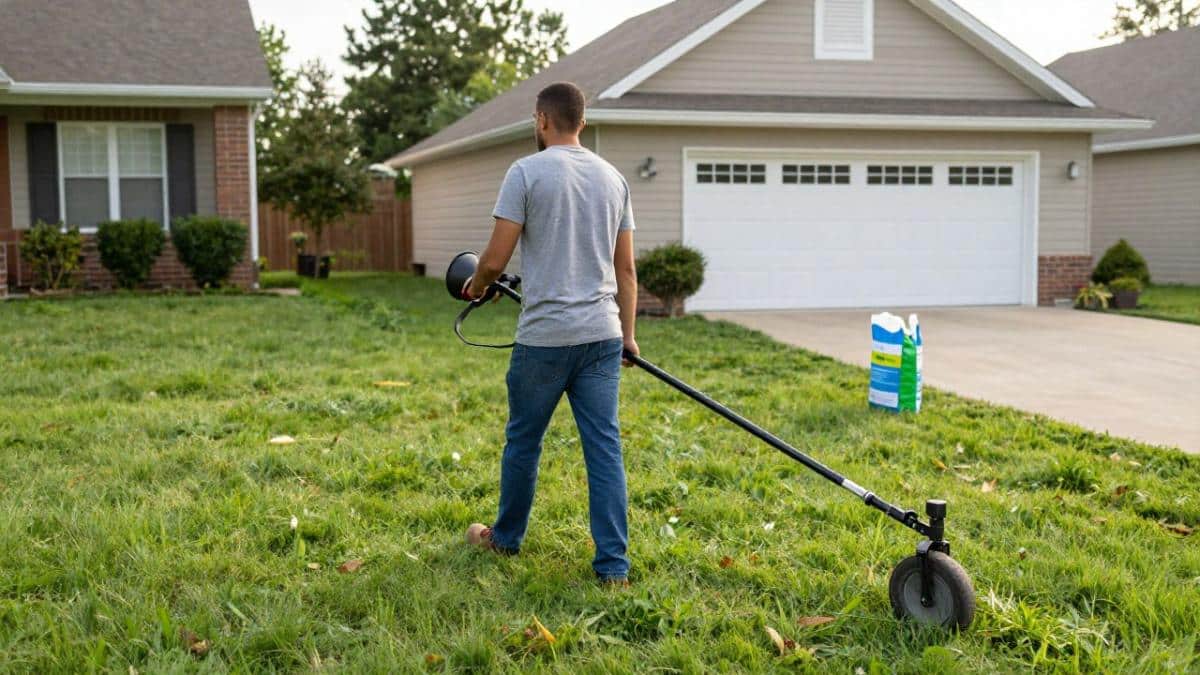
The right-angle pattern matters. It catches the streaks a single direction leaves behind, and it is how you avoid the striped look that shows up two weeks later.
Watering After Application: Why the Two Products Disagree
Watering is where most same-day plans fall apart, and it is also where most guides stay vague.
The gap most articles miss is the difference between activation watering and routine irrigation.
Use a label-first decision process instead of a universal yes-or-no answer. Before you water, compare both labels on four points:
- How much water. Each label states an amount, often in inches, sometimes as a range. Write both numbers down.
- How soon. Some labels say water immediately; others say within 24 hours; some say wait until the product has been down for a set period.
- What kind of water. A label may specify irrigation, rainfall, or either. If rain is forecast, that may satisfy one label and over-satisfy the other.
- What to avoid. Some labels warn against watering to the point of runoff or against watering within a set window after a weed killer pass.
Then sort the pair into one of four cases:
- Both want water: water both in together with one thorough pass. You are satisfying two activation requirements at once, which is the easy case.
- Grub product wants water, fertilizer does not: water lightly and evenly to move the grub product down without flooding the fertilizer off the lawn. Keep the pass short and even rather than long and soaking.
- Fertilizer wants water, grub product does not: wait. Apply the grub product on its own schedule so you are not forcing water onto a product that wants to stay dry.
- Neither wants water: leave the lawn alone and keep foot traffic off it for a day.
A practical rule: water enough to wet the soil, not enough to puddle. Runoff carries product into the gutter, where it helps nobody and can cause problems downstream.
Watch out: when the two labels give conflicting watering directions, do not split the difference. Follow the more restrictive label, separate the applications by a few days so each product gets its own schedule, or call the manufacturer’s number printed on the bag and ask. The stricter label wins because it is the one written to prevent the failure mode the manufacturer already knows about.
One more distinction worth keeping straight: activation watering is not a substitute for deep, infrequent irrigation later in the season. Once the product is activated, go back to watering for the lawn’s needs, not the product’s.
When to Apply Grub Control for Preventative Results
Preventative grub control works on a calendar, not on what you see. You apply it before the eggs hatch and the young larvae start feeding on your turf roots.
White grubs go through larval stages in the soil, and the small, newly hatched grubs are the easiest to stop.
Timing depends on your grass, your climate, and the local grub life cycle:
- Cool-season lawns: the window usually falls in late spring to early summer, ahead of the summer hatch.
- Warm-season lawns: the window shifts earlier, tied to that region’s hatch pattern.
- Watch the weather: a late, cool spring pushes the hatch back. A hot, early spring pulls it forward.
This is the piece national schedules miss. Readers in Carmel can find local timing guidance and professional lawn care in Carmel, IN that includes grub prevention in its seasonal program.
Newly seeded lawns, overseeding, and newly laid sod deserve their own note because they change the timing question.
A simple way to hold all of this together is a two-line calendar note: one line for your local hatch window from extension guidance, one line for the label’s application window. Noblesville readers can see how a local program schedules preventative grub control with lawn care in Noblesville, IN.
GrubEx Application Rate and Spreader Settings That Matter
The application rate is printed on the product bag and should be followed as the label directs. Read your bag for the exact figure and the spreader setting that matches it.
Two things trip people up:
- Spreader settings are brand-specific. A setting of 8 on one spreader is not setting 8 on another. Use the chart printed on the bag for your spreader model, or calibrate it yourself.
- Over-application is not “extra protection.” Putting down more than the label rate wastes product and can stress the turf.
Check your coverage math before you start. If the bag covers 5,000 square feet and your lawn is 6,000, buy a second bag. Running short mid-lawn leaves a strip with no protection, and that strip is exactly where grubs will show up next season.
For a full menu of treatments that bundle feeding and grub prevention, see our professional lawn care services.
Request a Quote for a Program That Handles Both
The hardest part of this job is not the spreader. It is holding two product labels, a hatch date, a watering schedule, and a spreader calibration in your head at the same time, then doing it again next season.
That is the work we do for homeowners across Hamilton County. We apply grub protection in the spring with a season-long guarantee.
You can see what our 7-step lawn care program covers, or get a free lawn care quote and we will send most quotes the same day.
Two bags, two labels, and one afternoon can handle both jobs, but only if you read before you spread. If you would rather hand the calendar and the calibration to a local team that knows Indiana lawns, Phenomalawn is ready. Our program includes professional-grade fertilizer, season-long weed control, and spring grub protection backed by a service guarantee.
Frequently Asked Questions
Can you apply grub control and fertilizer at the same time?
Yes, in most cases you can apply grub control and fertilizer at the same time, but the product labels decide whether that works on your lawn. Check both labels for restrictions on tank-mixing, spreader mixing, or applying to wet grass. If one product says not to combine it with another, apply them separately, even a few days apart. Applying them back to back is not the same as physically mixing them in one hopper.
Should you water the lawn after applying grub control and fertilizer?
Watering depends on what each label says. Many granular grub control products need water to move the active ingredient into the soil where grub larvae feed, with the amount stated on the label. Some fertilizer blends, especially slow-release formulas, prefer to be watered in lightly, while others should stay dry for a day. Read both labels and follow the stricter watering instruction. If they conflict, water for the grub product and choose a fertilizer that tolerates it.
When to apply fertilizer with grub control?
Timing depends on whether you use a preventative or curative grub product. Preventative grub control is usually applied in spring or early summer before grub eggs hatch, while curative products go down later when grubs are already active. Match the fertilizer to the season: a spring feeding for preventative timing, or a fall feeding if you are treating an active infestation. Always confirm the window on the label, since grass type and climate shift the ideal date.
What is the GrubEx application rate and can you put too much down?
The application rate is printed on the product bag and varies by formulation, so follow that number exactly rather than guessing. Yes, you can put too much grub killer down. Overapplying wastes product, can damage turf, and may violate the label, which is a legal document. Calibrate your spreader before you start, measure the lawn area first, and never double up on a pass to cover a missed strip.
